Reverse osmosis does not always require the same operating pressure. When the feed water has relatively low salinity, using a membrane designed for ultra-low-pressure operation can be an option worth evaluating. The objective is not simply to lower pressure, but to maintain useful permeate production and salt rejection while matching the membrane to the characteristics of the water source.
At Runmo, our ULP/XULP series is developed specifically for this type of application. These thin-film composite (TFC) membrane elements use polyamide composite materials and are designed to achieve permeate production and high desalination rates under ultra-low or extremely low pressure conditions. The operating pressure can be about two-thirds that of conventional composite membranes.
What Is a Low Pressure RO Membrane?
A low pressure RO membrane is a reverse osmosis element designed to achieve the required separation performance at a lower operating pressure than conventional RO membranes used for more challenging feed waters.
The relationship between feed-water salinity and operating pressure is important. Water with a lower concentration of dissolved salts generally does not present the same osmotic-pressure challenge as seawater or highly saline water. This creates an opportunity to use a membrane specifically developed for lower-pressure operation.
Our ULP/XULP series uses polyamide TFC membrane technology and is intended for surface water, groundwater, tap water, and municipal water with salt content below 2,000 ppm. The published desalination rate can reach 99.3% under the stated product conditions.
Why Consider Lower Operating Pressure?
Reducing operating pressure can influence more than the membrane itself. A reverse osmosis system also depends on high-pressure pumps, pipelines, pressure vessels, and other supporting equipment.
The lower operating pressure can help reduce the investment cost of related pumps, pipelines, containers, and other equipment, while also reducing the operating cost of the overall RO system.
This does not mean that every low-salinity application should automatically use a ULP membrane. The system still needs to meet its required permeate flow and rejection target. For this reason, we recommend evaluating water quality and system requirements together rather than selecting a membrane based only on pressure.
Where Are Low Pressure RO Membranes Commonly Used?
Surface Water and Groundwater
Our ULP/XULP series is suitable for desalination treatment of surface water and groundwater with salt content below 2,000 ppm. These sources can have substantially different compositions, so membrane selection should still be based on actual water analysis.
For example, two groundwater sources may have similar TDS levels but different hardness, organic loading, turbidity, or other characteristics. These factors can affect pretreatment requirements and membrane operation.
Tap Water and Municipal Water
Tap water and municipal water are also listed among the intended feed-water sources for our ULP/XULP series when the salt content is below 2,000 ppm.
In these applications, the membrane can be considered when the treatment process requires additional desalination or purification after conventional water treatment. The actual role of RO depends on the required product-water quality and the composition of the incoming water.
Industrial Water Preparation
We also list the ULP/XULP series for industrial applications including pure-water preparation, boiler recharge water, food processing, and pharmaceutical manufacturing.
These applications can benefit from matching membrane operating pressure to the feed-water conditions. Where the water source has relatively low salinity, a ULP configuration may provide a practical alternative to using a conventional RO element designed for more demanding feed-water conditions.
What Models Are Available?
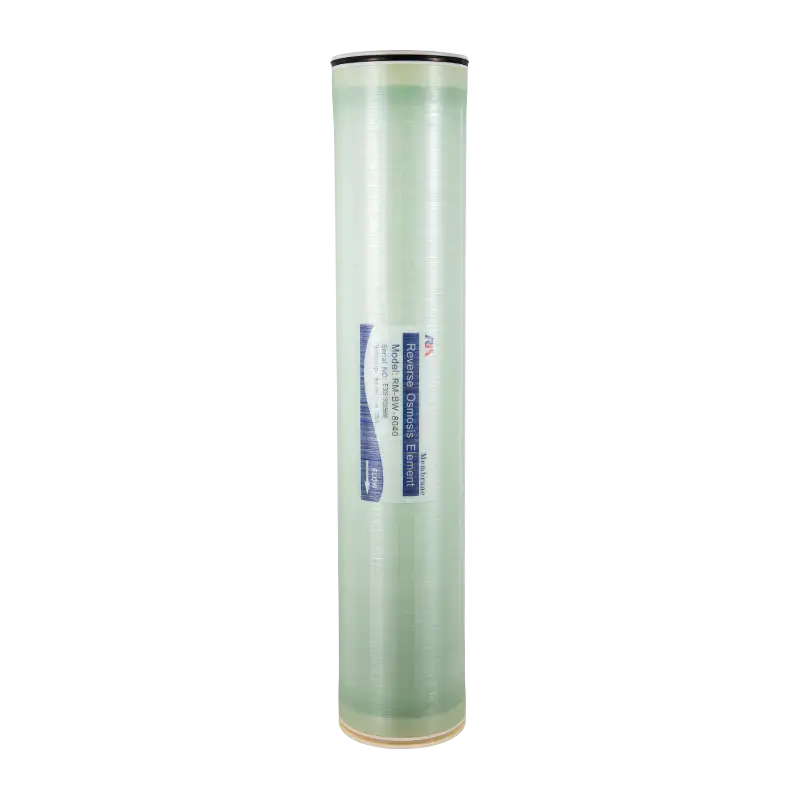
Our ULP/XULP range covers several membrane areas and capacity levels. For example, the RM-ULP-2521 has a membrane area of 16 ft² (1.5 m²) and an average permeate flow of 300 GPD (1.13 m³/day), while the RM-ULP-8040 provides 400 ft² (37 m²) of membrane area and an average permeate flow of 10,500 GPD (39.5 m³/day).
Other options include the RM-XULP-4021, RM-XULP-4040, RM-ULP-2540, RM-ULP-4021, RM-ULPD-4040, RM-ULPH-4040, and RM-ULP31-4040. Their average permeate flows range from 750 to 2,300 GPD across the listed 2540 and 4040-format models, while the RM-ULP31-4040 is listed at 1,900 GPD.
The published figures are based on specific testing conditions, so they should be used as reference values rather than assumed field performance.
What Should Be Checked Before Selection?
Before choosing a low pressure RO membrane, we recommend starting with the feed-water analysis. TDS is important because our ULP/XULP series is designed for feed water below 2,000 ppm salt content, but other parameters also affect operation.
Our published operating limits include a maximum feed-water SDI15 of 5, maximum temperature of 45°C, continuous operating pH of 2–12, and maximum turbidity of 1 NTU. The listed maximum feed-water values include COD of 10 ppm, BOD of 5 ppm, TOC of 10 ppm, hardness of 60 ppm, and residual chlorine below 0.1 ppm.
System designers should also consider the required permeate capacity and the feed-flow limits of each membrane element. For example, the maximum feed-water flow for the 8040 model is listed as 75 gpm (17 m³/h), while smaller elements have lower flow limits. These specifications should be reviewed alongside the expected system capacity and overall operating conditions before selecting a suitable membrane.